Restaurant Insurance: The Coverage You Actually Need (And Why It Matters)
Running a restaurant is hard enough without worrying about whether you're properly protected. Most restaurant owners focus on food, staff, and customers—but then a slip-and-fall lawsuit or kitchen fire happens, and suddenly you realize your insurance wasn't what you thought it was.

This is where restaurant insurance gets complicated. Not all business policies are created equal, and the wrong coverage can cost you thousands—or worse, put you out of business.
Let's break down what restaurant owners actually need to know about commercial insurance.
The Real Cost of Being Under-Insured
Here's the thing: a standard small business policy won't cut it for a restaurant. Your exposure is different. You're serving food to the public, handling alcohol (if you're licensed), managing employees, and dealing with equipment that can fail catastrophically.
A kitchen fire that destroys your cooking equipment, inventory, and forces you to close for two weeks? That's not just about replacing equipment—that's lost revenue, rent obligations, and payroll you still have to cover. A customer gets food poisoning and sues? Your standard liability might not be enough.
We've seen it happen. Restaurant owners get hit with claims they never expected, and their insurance doesn't cover it—or doesn't cover it fully.
The difference between adequate coverage and inadequate coverage often comes down to one conversation with the right broker.
What Restaurant Insurance Actually Covers (And What It Doesn't)
Restaurant business insurance typically includes several layers:
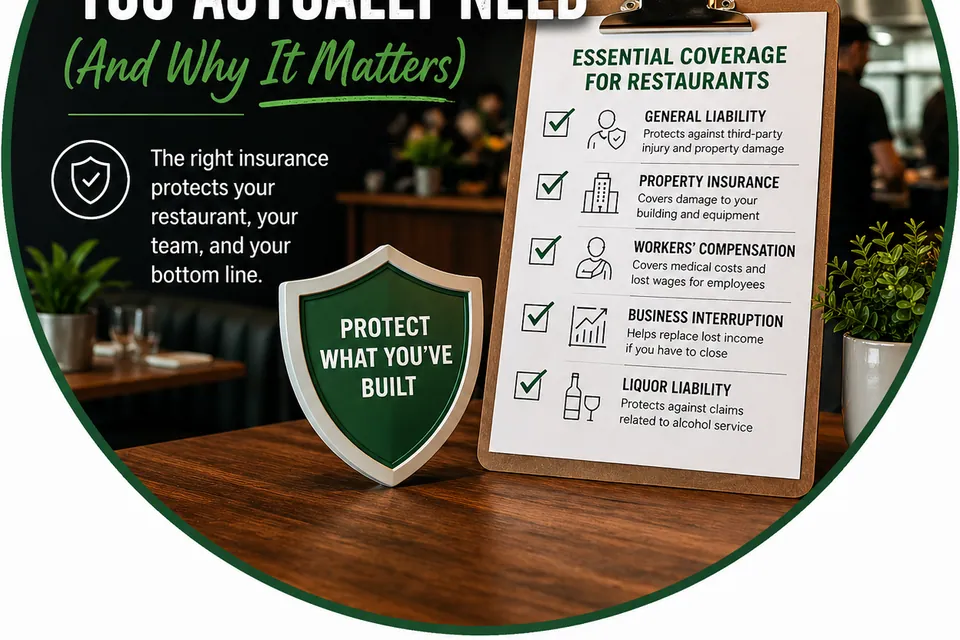
Commercial General Liability This covers bodily injury and property damage claims. A customer slips on a wet floor and breaks their arm—liability covers their medical bills and legal costs. Someone's property gets damaged in your restaurant—covered. This is foundational, but it's not enough on its own.
Property insurance: Identify the building, equipment, stock and improvements you need insured. Check the covered causes of loss, valuation basis, limits and exclusions. Keep equipment values current and discuss replacement costs with your insurance representative.
Business Interruption Insurance This is the one owners forget about until disaster strikes. If your restaurant has to close due to a covered event (fire, equipment failure, forced closure by health department), business interruption covers lost revenue and ongoing expenses like rent and utilities. Without it, you're bleeding cash while you rebuild.
Liquor Liability (if applicable) If you serve alcohol, you need this. It covers liability claims related to alcohol service—things like over-service or intoxicated patrons causing harm. Regular general liability won't cover this.
Employment Practices Liability Employment disputes happen. This covers claims related to wrongful termination, discrimination, or harassment. In today's environment, this is increasingly important.
Commercial Auto Insurance If your restaurant does deliveries, catering, or has commercial vehicles, you need commercial auto coverage—not personal auto. The distinction matters legally and financially.
The Coverage Gap Most Restaurants Miss
Here's where it gets real: many restaurant owners think they're covered, but they've actually got gaps.
Valuation Method Matters Some policies use "replacement cost"—what it actually costs to replace something today. Others use "actual cash value," which factors in depreciation. If your 10-year-old commercial kitchen equipment needs replacing, ACV will pay you way less than replacement cost. For restaurants, replacement cost is almost always the better choice, but it costs more upfront.
Co-Insurance Traps Some commercial policies include co-insurance clauses. Basically, you agree to insure your property for a certain percentage of its value (usually 80-90%). If you underinsure, the insurance company won't pay claims in full—they'll penalize you proportionally. We've seen restaurants lose tens of thousands because they didn't understand this clause when they bought the policy.
Business Interruption Limits Even if you have BI coverage, it might not be enough. Coverage typically caps at 12 months of lost revenue, but rebuilding a restaurant can take longer. Some policies also have waiting periods—you might not collect until day 5 or day 10 of a closure. That matters when you're losing money daily.
What's NOT Covered Spoilage (food going bad due to power outage) often isn't covered automatically—you need a specific endorsement. Damage from lack of maintenance isn't covered. Claims from your own negligence are handled differently than third-party claims. Know the exclusions.
How to Actually Choose the Right Coverage
Step 1: Honest Assessment of Your Risk Walk through your restaurant. What's your biggest exposure? Is it customer-facing (slip-and-fall risk)? Equipment-dependent (what if your fryer breaks)? Alcohol service? Multiple locations? Peak season dependency? The answer shapes what you prioritize.
Step 2: Know Your Numbers What's your annual revenue? What's the replacement cost of your equipment and inventory? How long could you survive without revenue? These numbers determine your coverage limits. Underestimating them is a common mistake.
Compare the coverage behind the premium. Check deductibles, business interruption terms and whether property claims use replacement cost or actual cash value. Work through the same hypothetical loss under each proposal before choosing.
Step 4: Work With Someone Who Gets Restaurants This is non-negotiable. A broker who understands restaurant operations, typical claims, and industry-specific risks will ask better questions and spot gaps faster. Someone selling you a generic commercial policy might miss critical stuff.
The Questions Your Broker Should Ask (And If They Don't, That's a Red Flag)
- Do you serve alcohol? What's your service model?
- Do you have a commissary or central kitchen location?
- How much inventory do you typically carry?
- What's the replacement cost of your equipment?
- Do you do any catering, delivery, or off-premises service?
- How many locations? Are they all the same risk profile?
- What's your annual payroll?
- Have you had any claims or losses in the past?
- How long would it take to rebuild if you had a major loss?
If a broker doesn't ask these things, they're not doing their job.
Real Scenarios: Where Coverage Gets Tested
Scenario 1: Kitchen Fire A fire starts in your fryer and spreads to the hood system. Your restaurant is closed for 8 weeks while repairs happen. You still have rent, utilities, and staff payroll. With adequate property and business interruption coverage, you're protected. Without it, you're paying out of pocket while your revenue is zero.
Scenario: a customer alleges food poisoning. Ask the insurer or broker which liability coverage could respond, how defence costs work, and what exclusions, deductible and limits apply. A claim amount below the headline limit does not, on its own, establish coverage or an adequate limit.
Scenario: a refrigerator fails and food spoils. Ask separately about equipment breakdown and stock spoilage. Confirm which causes of loss, temperature changes, service interruptions and reporting requirements are covered; equipment replacement and spoiled stock are different questions.
Scenario: a former employee alleges wrongful dismissal. Ask whether employment practices liability or another policy addresses that allegation, including defence, exclusions, reporting and any deductible. Do not assume a general liability policy covers the dispute.
What You Should Do Right Now
- Review Your Current Policy — Don't just assume you know what you have. Pull your declarations page and actually read it. What are your limits? What are your deductibles? What's excluded?
- Run the Numbers — Calculate your annual revenue, equipment replacement cost, and inventory value. Compare these to your coverage limits. Are there gaps?
- Talk to Your Broker — Not a sales call—a real assessment. Ask them to walk you through your coverage, explain any gaps, and show you what a claim would actually pay out.
- Consider Your Growth — If you're expanding locations or increasing menu complexity, your risk profile changes. Your coverage should too.
- Get a Second Opinion — Especially if you haven't reviewed your policy in 2+ years. Insurance needs evolve, and rates change. There might be better options out there.
The Bottom Line
Restaurant insurance isn't complicated—it just requires attention to detail and asking the right questions. Most restaurants are either over-insured (paying for coverage they don't need) or under-insured (gambling with gaps they don't realize exist).
The sweet spot is coverage that matches your actual risk, with limits that protect your business, and clarity on what's covered and what's not.
If you're running a restaurant and haven't had a serious insurance conversation in the past year, that's your sign to schedule one. It's the conversation that saves you thousands—and sometimes saves your entire business.
Further reading: FSRA: reviewing commercial insurance and premiums